This reference documents every validation code produced by the RONL DMN+ syntactic validator, the rule each code enforces, and the rationale for why that rule exists. The validator runs on the shared backend at POST /v1/dmns/validate and is used both by the Linked Data Explorer's standalone DMN Validator view and by the CPSV Editor's inline validation in the DMN tab.
Layer 1 checks that the file is a structurally sound XML document with the correct root element and namespace. These checks run first; if they fail, layers 2–5 are skipped entirely because a broken document cannot be safely traversed.
libxmljs2.parseXml() throws a SyntaxError — the file is not well-formed XML
Rationale
DMN files are XML documents. A parser error means the file cannot be read at all — not by the validator, not by Operaton, not by any other DMN tooling. This is the most fundamental failure mode.
Fix
Open the file in a text editor or XML validator. Common causes: unclosed tags, illegal characters in attribute values, missing XML declaration encoding, byte-order mark (BOM) at the start of the file. The line and column fields on the issue pinpoint the exact location.
The DMN 1.x specification mandates <definitions> as the document root. A different root element means the file is either not a DMN file, is a fragment, or has been corrupted.
Fix
Ensure the file starts with <definitions xmlns="https://www.omg.org/spec/DMN/20191111/MODEL/" ...>.
The namespace URI on <definitions> is not one of the recognised DMN namespaces
Rationale
Each DMN version uses a distinct namespace URI. The validator recognises: DMN 1.3 (https://www.omg.org/spec/DMN/20191111/MODEL/), DMN 1.2 (http://www.omg.org/spec/DMN/20180521/MODEL/), DMN 1.1 (http://www.omg.org/spec/DMN/20151101/dmn.xsd), and the Camunda legacy namespace (https://www.camunda.org/schema/1.0/dmn). An unrecognised namespace causes XPath queries in layers 2–5 to fail silently, producing incomplete validation results and unexpected Operaton behaviour.
Fix
Update xmlns on <definitions> to a recognised namespace. For new files, use the DMN 1.3 namespace.
<definitions> is missing the name attribute or its value is empty
Rationale
The DMN specification requires a name on <definitions>. Operaton uses this name in its deployment UI. A missing name makes it harder to identify a model in the engine and in TriplyDB metadata.
Fix
Add name="YourModelName" to the <definitions> element.
<definitions> is missing the namespace attribute or its value is empty
Rationale
The namespace attribute defines the target namespace for the model's identifiers. Without it, URIs generated from decision IDs are ambiguous. For RONL publishing, this value is used as the base URI for the decision model's linked data identity.
Fix
Add namespace="https://regels.overheid.nl/services/{your-service-id}/dmn" to <definitions>.
A DMN file with no decisions contains no executable logic. This typically indicates an empty template, a partially authored file, or a file that only contains <inputData> definitions without the associated decisions.
Fix
Add at least one <decision> element, or verify that the correct file was uploaded.
Layer 2 checks the structural correctness of decision table definitions: that enumerations are valid, that type declarations are present, that rule rows are internally consistent, and that hit-policy constraints are not violated by the static structure of the table.
A <decisionTable> has a hitPolicy attribute whose value is not in the allowed set: UNIQUE, FIRST, ANY, COLLECT, RULE ORDER, OUTPUT ORDER, PRIORITY
Rationale
Operaton implements the full DMN 1.3 hit policy set but will reject unknown values at deployment time with a cryptic parse error. Catching this before deployment saves a round-trip to the engine.
Fix
Correct the hitPolicy value on the <decisionTable> element. If no hit policy is specified, UNIQUE is the default.
An <inputExpression> inside a decision table is missing a typeRef attribute
Rationale
typeRef declares the FEEL type of the input column. Without it, Operaton performs no type coercion — a string "true" is not automatically cast to boolean true, which causes rules to never match if the FEEL type does not align with the runtime variable type. For RONL publishing, typed inputs are required for semantic interoperability.
Fix
Add typeRef="boolean" (or string, integer, date, etc.) to the <inputExpression>.
An <inputExpression> has a typeRef value that is not a known DMN FEEL type
Rationale
Known types are: string, boolean, integer, long, double, number, date, and their capitalised variants. An unknown type (e.g. a misspelling or a custom type name) means the type declaration is present but non-functional.
Fix
Replace the custom or misspelled type with the correct FEEL type name.
An <o> column in a decision table is missing a typeRef attribute
Rationale
Without a typed output, consuming systems (including the Linked Data Explorer's chain builder) cannot validate that the output type of one DMN matches the expected input type of the next DMN in a chain. This is a prerequisite for type-safe chain composition.
An <o> column has a typeRef value that is not a known DMN FEEL type
Rationale
An unrecognised output type cannot be mapped to a FEEL type at runtime and cannot be matched against the input types of downstream decisions in a chain. This typically indicates a typo or a custom type name that should be replaced with a standard FEEL type.
Fix
Replace the value with a known FEEL type: string, boolean, integer, long, double, number, or date.
A <rule> has a different number of <inputEntry> elements than there are <input> columns declared on the parent <decisionTable>
Rationale
DMN requires exactly one <inputEntry> per input column per rule. A mismatch means the table is malformed — Operaton will either throw a parse error at deployment time or silently misalign entries, causing incorrect rule evaluation.
Fix
Ensure every <rule> contains exactly as many <inputEntry> elements as there are <input> columns in the table.
A <rule> has a different number of <outputEntry> elements than there are <o> columns declared on the parent <decisionTable>
Rationale
DMN requires at least one <outputEntry> per output column per rule. A mismatch means the table is malformed — Operaton will either throw a parse error or produce null output values for the misaligned columns.
Fix
Ensure every <rule> contains exactly as many <outputEntry> elements as there are <o> columns in the table.
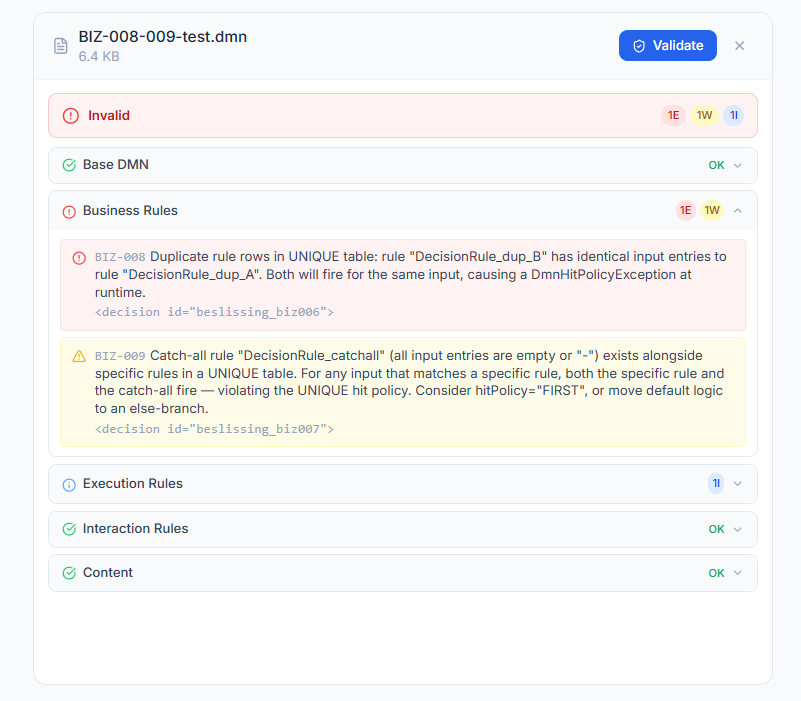
Two rules in a UNIQUE or ANY decision table have byte-identical text in every <inputEntry> column
Rationale
A UNIQUE table requires that at most one rule fires for any given input. When two rules have identical input entries, both fire for every input that satisfies those entries. Operaton throws DmnHitPolicyException at runtime. This is undetectable from the output alone — the engine throws before producing a result.
Fix
Remove or differentiate the duplicate rule. If the intent is to produce a combined output, consider hitPolicy="COLLECT" with an aggregator, or merge the two rules into one.
A UNIQUE or ANY decision table contains a catch-all rule (every <inputEntry> is empty or -) alongside at least one specific rule
Rationale
An empty or - input entry matches any value. A rule where all inputs are empty or - therefore matches every possible input combination. In a UNIQUE or ANY table, this catch-all overlaps with every specific rule — for any input that satisfies a specific rule, both the specific rule and the catch-all fire simultaneously, violating the hit policy. This is the most common overlap pattern in government DMNs and the hardest to spot visually.
Fix
Change hitPolicy to FIRST and place the catch-all last (it then only fires when no specific rule matches), or replace the catch-all with explicit rules covering the remaining input combinations.
BIZ-008-009-test.dmn loaded in the DMN Validator showing Business Rules 1E 1W — BIZ-008 error on the duplicate-rows decision and BIZ-009 warning on the catch-all decision
Layer 3 validates CPRMV extension attributes. The CPRMV namespace (https://cprmv.open-regels.nl/0.3.0/) is defined by the RONL initiative to capture the legal provenance and classification of each decision rule. These attributes are required for RONL-compliant publishing but are not enforced by Operaton itself.
No element in the document has an attribute in the CPRMV namespace
Rationale
CPRMV attributes are the mechanism by which a DMN file records its connection to Dutch legislation. Without them, the exported Turtle will contain no legal provenance metadata. The issue is info rather than warning because a DMN may be published to TriplyDB as a technical artefact before CPRMV metadata has been added.
Fix
Add CPRMV namespace declaration to <definitions>: xmlns:cprmv="https://cprmv.open-regels.nl/0.3.0/", then add attributes such as cprmv:rulesetType, cprmv:ruleType, and cprmv:confidence to your decision elements.
A cprmv:rulesetType attribute has a value that is not in the allowed set: decision-table, conditional-calculation, constraint-table, derivation-table
Rationale
rulesetType classifies the structural pattern of the ruleset. An invalid value means the classification cannot be interpreted by downstream systems that use this attribute to determine how to present or execute the ruleset.
Fix
Set cprmv:rulesetType to one of the four allowed values.
A cprmv:implements attribute value does not match the BWB ID format (BWBR + 7 digits, e.g. BWBR0002221)
Rationale
BWB IDs are the persistent identifiers for Dutch legislation on wetten.overheid.nl. A malformed value cannot be resolved to a legislation page, breaking the link between the DMN and its legal source.
Fix
Use the correct BWB ID. BWB IDs are found in the URL of the legislation on wetten.overheid.nl.
A cprmv:ruleType attribute has a value not in: temporal-period, conditional, derivation, constraint, decision-rule, default
Rationale
ruleType classifies the logical nature of an individual rule. The six types map to distinct patterns in Dutch administrative law. An unknown value cannot be processed by RONL vocabulary services.
Fix
Set cprmv:ruleType to one of the six allowed values.
A cprmv:confidence attribute has a value not in: low, medium, high
Rationale
confidence expresses how certain the rule author is that the DMN correctly implements the underlying legislation. An invalid value cannot be interpreted by governance tooling.
A cprmv:validFrom attribute has a value that does not match YYYY-MM-DD
Rationale
CPRMV dates are ISO 8601 calendar dates. A malformed date cannot be parsed for temporal reasoning — for example, determining whether a rule is currently in effect.
Layer 4 validates the Decision Requirements Diagram (DRD) — the graph of decisions and information requirements that connects inputs to the final decision output.
An <informationRequirement> contains a <requiredInput> whose href references an <inputData> ID that does not exist in the document
Rationale
A broken href means Operaton cannot locate the dependency at runtime, causing a NullPointerException or silent evaluation failure. This is particularly common after copy-paste from another DMN file where IDs were not updated.
Fix
Verify that every href="#some-id" in <requiredInput> elements corresponds to the id of an <inputData> element in the same document.
An <informationRequirement> element has neither a <requiredInput> nor a <requiredDecision> child
Rationale
An <informationRequirement> with no referenced element is an empty declaration that contributes nothing to the DRD. It may indicate an incomplete authoring step.
Fix
Add the appropriate <requiredInput> or <requiredDecision> child, or remove the empty <informationRequirement>.
An <inputData> element exists in the document but is not referenced by any <informationRequirement>. Only fires in DRDs — models with more than one <decision> element or at least one <informationRequirement>. In standalone single-decision DMNs, <inputData> elements serve as input contract declarations for CPSV/publishing purposes and do not require wiring.
Rationale
An orphaned <inputData> element in a DRD declares an input that no decision uses. It adds clutter to the DRD, makes the model harder to understand, and causes the CPSV Editor to generate cpsv:Input metadata for an input that has no effect on any decision outcome.
Fix
Connect the <inputData> element to a decision via <informationRequirement>, or remove it from the model.
An <inputData> element has a name attribute that does not match the name of its child <variable> element
Rationale
Operaton resolves inputs by variable name at runtime. A mismatch between the <inputData name="..."> and its <variable name="..."> is a common source of "my rule never fires" bugs where the input evaluates to null.
Fix
Align the <variable name="..."> with the <inputData name="...">.
An <inputExpression> references a variable name that has no corresponding top-level <inputData name="..."> declaration in the <definitions> element. Not checked for empty expressions, literal booleans (true / false), or numeric and quoted-string literals — these are hardcoded values, not variable references.
Rationale
Without a matching <inputData> declaration, the CPSV Editor cannot discover the DMN's input contract and generates an empty request body on deploy. Adding <inputData> elements with <variable> children makes the input contract explicit for both tooling and human readers.
Fix
For each flagged variable name, add a top-level <inputData id="InputData_<n>" name="<n>"> element with a <variable id="Variable_<n>" name="<n>" typeRef="<type>" /> child, placed between </decision> and <dmndi:DMNDI>.
Layer 5 checks metadata quality: whether descriptive attributes are populated and whether elements that should carry content actually do. These checks have no functional impact on execution but are required for RONL publishing quality.
A CPRMV descriptive attribute (cprmv:title or cprmv:description) is present on a <decision> but its value is empty
Rationale
CPRMV descriptive attributes are used by the Linked Data Explorer and TriplyDB to display human-readable metadata about rules. An empty attribute signals that the author added the placeholder without filling it in.
Fix
Add meaningful text to the attribute, or remove it if it is not applicable.
A cprmv:note attribute on a <rule> is present but empty
Rationale
Rule-level notes are used to explain the intent of a specific rule row in human-readable terms. An empty note is a placeholder that was never completed.
Fix
Add a note describing the rule's intent or remove the attribute.
A <variable> element anywhere in the document is missing a typeRef attribute
Rationale
The typeRef on a <variable> declares the FEEL type of the value it represents. Without it, consuming decisions in a DRD cannot perform type-safe input binding, and the chain builder in the Linked Data Explorer cannot verify type compatibility between linked DMNs.
{"severity":"warning","code":"BIZ-009","message":"Catch-all rule \"DecisionRule_catchall\" (all input entries are empty or \"-\") exists alongside specific rules in a UNIQUE table. For any input that matches a specific rule, both the specific rule and the catch-all fire — violating the UNIQUE hit policy. Consider hitPolicy=\"FIRST\", or move default logic to an else-branch.","location":"<decision id=\"beslissing_biz009\">"}
Response (parse error — layers 2–5 skipped):
{"success":true,"data":{"valid":false,"parseError":"XML is not well-formed: ...","layers":{"base":{"label":"Base DMN","issues":[{"severity":"error","code":"BASE-PARSE",...}]},"business":{"label":"Business Rules","issues":[]},"execution":{"label":"Execution Rules","issues":[]},"interaction":{"label":"Interaction Rules","issues":[]},"content":{"label":"Content","issues":[]}},"summary":{"errors":1,"warnings":0,"infos":0}},"timestamp":"..."}
Response (bad request):
{"success":false,"error":{"code":"INVALID_REQUEST","message":"Request body must contain a \"content\" field with the DMN XML as a string."},"timestamp":"..."}
The endpoint is unauthenticated. Maximum request body size is 10 MB.