Rules, Policy & Parameters
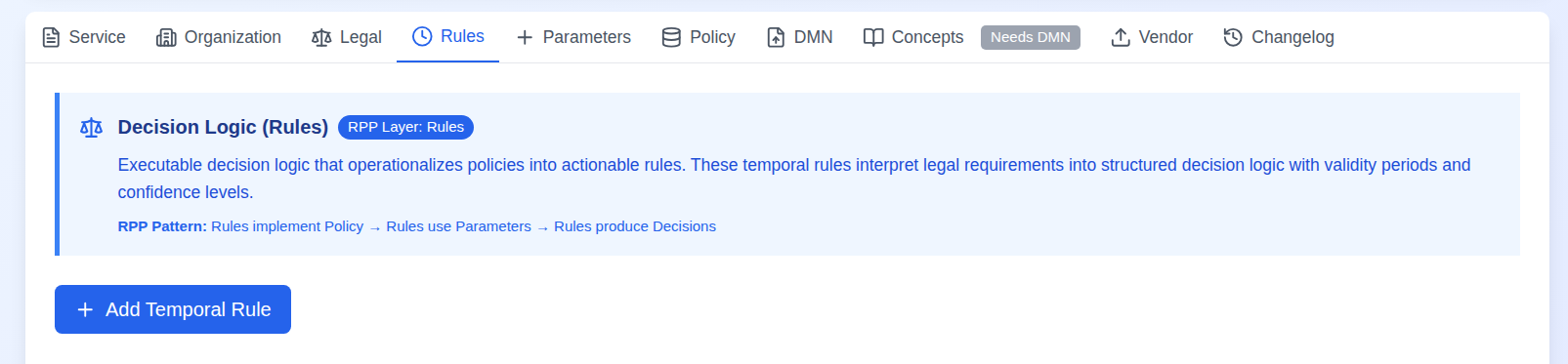
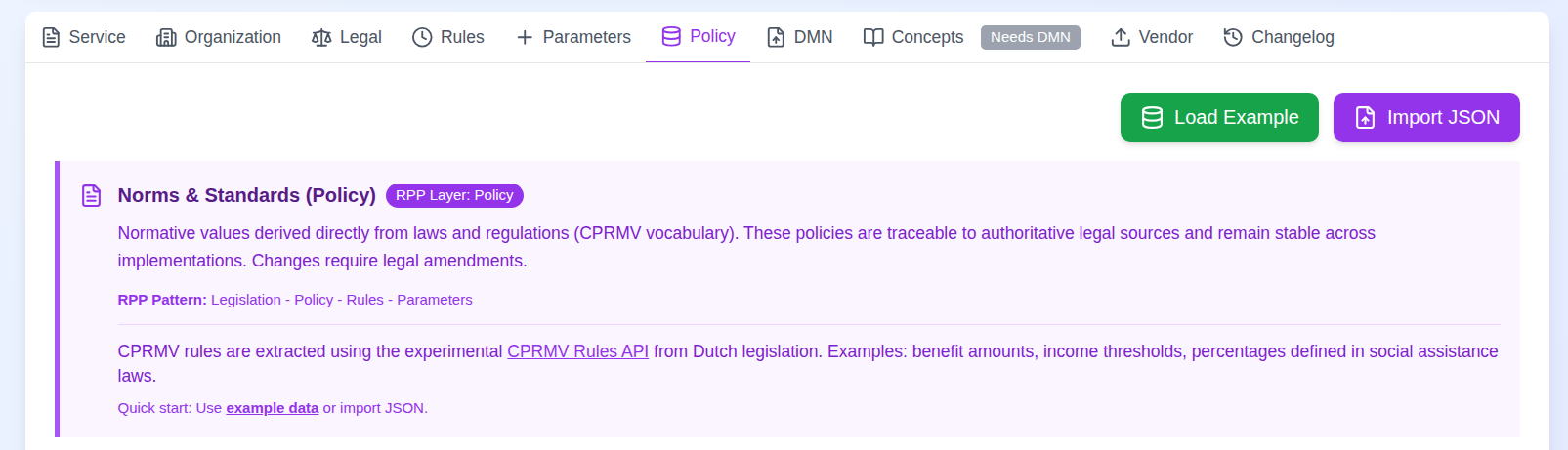
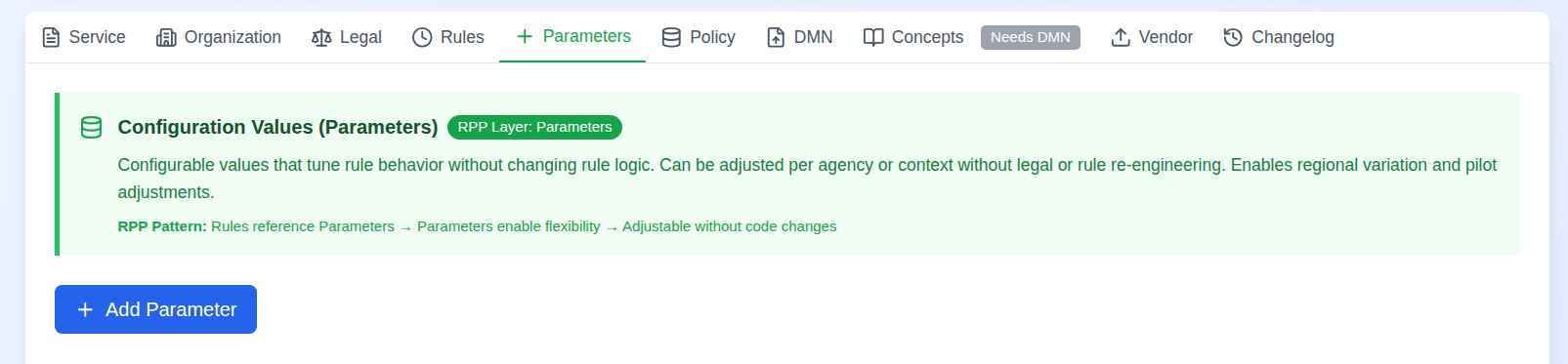
The editor implements the Rules–Policy–Parameters (RPP) architectural pattern for structuring government business rule management. Three separate tabs map to the three layers of this pattern, each visually distinguished by colour and labelled with its RPP role.
The three layers
| Layer | Tab | Colour | RDF class | Description |
|---|---|---|---|---|
| Rules | Rules | 🔵 Blue | cpsv:Rule, cprmv:TemporalRule |
Executable decision logic that operationalises policy |
| Policy | CPRMV | 🟣 Purple | cprmv:Rule (grouped in cprmv:RuleSet) |
Normative values derived directly from legislation |
| Parameters | Parameters | 🟢 Green | cprmv:ParameterWaarde |
Configurable values that tune rule behaviour |
Rules layer
Rules are time-bounded (cprmv:TemporalRule) business rules that implement policy decisions. Each rule carries a mandatory identifier, title and description, an optional URI, temporal validity dates (cprmv:validFrom, cprmv:validUntil), a confidence level (cprmv:confidenceLevel), and an extension reference (cprmv:isBasedOn) that links the rule to a specific article or version of the legal resource. When a legal resource is set, the rule's cpsv:implements points at the eli:LegalResource (as CPSV-AP's RuleShape requires), not the service.
The dual typing a cpsv:Rule, cprmv:TemporalRule ensures both CPSV-AP 3.2.0 compliance and compatibility with the Dutch CPRMV extensions.
Vocabulary migration (v2.0.0)
Temporal-rule typing and properties moved from the ronl: namespace to cprmv:
(ronl:TemporalRule → cprmv:TemporalRule, ronl:validFrom/validUntil/confidenceLevel
→ cprmv:…, ronl:extends → cprmv:isBasedOn). The ronl: namespace is now reserved
for governance (validation, certification, vendor). Legacy files still import correctly.
Policy layer (CPRMV)
The CPRMV tab captures normative rules extracted directly from legislation — the values mandated by law rather than the computational logic that applies them. These are modelled as cprmv:Rule and imported either by loading JSON or by filling in individual fields.
Each CPRMV rule has six fields: rule id (cprmv:id), ruleset id (cprmv:rulesetId), definition (full legal text, cprmv:definition), situational context (cprmv:situatie), the normative value itself (cprmv:norm), and the legal source path (cprmv:ruleIdPath).
CPRMV 0.4.1 RuleSets. On export, every unique rulesetId produces a conformant cprmv:RuleSet — carrying cprmv:id, cprmv:validFrom, cprmv:isOutputOf (→ the public service), a dual-typed cprmv:RuleMethod, an ordered cprmv:hasPart list of its rules, and a prov:wasDerivedFrom link to the legal source. This replaces the v1.9.4 cprmv:Dataset block. See CPRMV RuleSet Generation.
Importing the CPRMV Rules API output. The Import JSON button (and the CPRMV tab's Load Example) accept the CPRMV 0.4.1 Rules API shape — an array of cprmv:RuleSet objects with nested …#hasPart maps — as well as legacy 0.3.0 and flat-array exports. flattenCprmvRules (src/utils/cprmvImport.js) walks and flattens nested sub-rules into the editor's flat model, with nested rules inheriting their parent's rulesetId.
An informational banner in the CPRMV tab shows the currently linked legal resource and the cprmv:implements property that creates an explicit semantic link between a policy rule and the versioned legislation it implements — enabling clean SPARQL queries without fragile string parsing.
Parameters layer
Parameters are configurable constants that tune rule behaviour without changing the rules themselves — for example, income thresholds, age limits, or regional rates. Modelled as cprmv:ParameterWaarde (was ronl:ParameterWaarde before v2.0.0), each parameter carries a machine-readable notation (skos:notation), a numeric value and unit (schema:value, schema:unitCode), and optional temporal validity (cprmv:validFrom, cprmv:validUntil). Both the notation and the human-readable label (skos:prefLabel) are mandatory — the editor enforces them client-side to mirror the cprmv:ParameterWaardeShape SHACL constraint, regardless of whether a value is set (v1.10.4).
Why this separation matters
The RPP pattern creates a clear chain of traceability: Law → Policy → Rule → Parameter → Decision. The practical benefits are:
Legal traceability. Every decision can be traced back to the specific article of legislation that mandates it. When legislation changes, the affected layer is immediately identifiable.
Organisational agility. Parameters can be adjusted (e.g. a regional pilot rate) without touching the rules or redeploying decision models. Rules can be versioned without touching the underlying policy statements.
Governance clarity. Each layer has distinct ownership. Policy rules are owned by legal teams, computational rules by analysts, and parameters by operational teams. Approval workflows can be scoped to the layer that actually changed.
See RPP Architecture Reference for the formal specification.