Operaton MCP Client
This page documents the operaton-mcp-client Keycloak client and the /v1/m2m/* route group that exposes the full Operaton surface to machine-to-machine (M2M) callers without tenant scoping.
Access pattern
This feature uses Pattern 3 — RONL Business API M2M routes from the Operaton Access Patterns reference. Callers interact with Operaton through the RONL Business API, not directly with engine-rest. This gives the platform audit logging, a curation gate, and RONL-shaped response envelopes — at the cost of a narrower operation surface compared to Pattern 2.
There are two distinct authentication hops in this pattern:
-
Caller → RONL Business API — the
operaton-mcp-clientKeycloak client obtains a JWT via OAuth 2.0 Client Credentials and presents it asAuthorization: Bearer <token>.jwtMiddlewareinm2m.routes.tsvalidates the token;tenantMiddlewareis intentionally absent, so nomunicipalityclaim is required or expected. -
RONL Business API → Operaton — the backend calls Operaton using basic auth via a dedicated
OperatonServiceinstance, configured fromOPERATON_M2M_BASE_URL,OPERATON_M2M_USERNAME, andOPERATON_M2M_PASSWORD. WhenOPERATON_M2M_BASE_URLis unset, the M2M routes fall back to the shared default Operaton instance:
The M2M_ALLOWED_OPERATIONS constant in m2m.routes.ts acts as a curation gate — any operation not listed returns 403 OPERATION_NOT_PERMITTED regardless of what Operaton supports. This is the key structural difference from Pattern 2, which exposes the full engine-rest surface with no curation.
Architecture
Regular RONL Business API routes (/v1/process, /v1/task, /v1/decision) enforce tenant isolation via tenantMiddleware — every request must carry a municipality JWT claim and data is filtered to that organisation. This is correct for human caseworkers but wrong for system actors such as an MCP agent that needs a cross-organisation view of Operaton.
The M2M API solves this with a dedicated route group that applies only jwtMiddleware:
MCP Client / Automation tool
    │
    │  1. POST /token  (client_credentials)
    ▼
Keycloak (acc.keycloak.open-regels.nl)
    │
    │  2. access_token (JWT, aud: ronl-business-api)
    │     no municipality claim
    ▼
RONL Business API (acc.api.open-regels.nl)
    │  jwtMiddleware validates token
    │  no tenantMiddleware — no organisation filter
    ▼
Operaton (operaton-doc.open-regels.nl)
Keycloak client
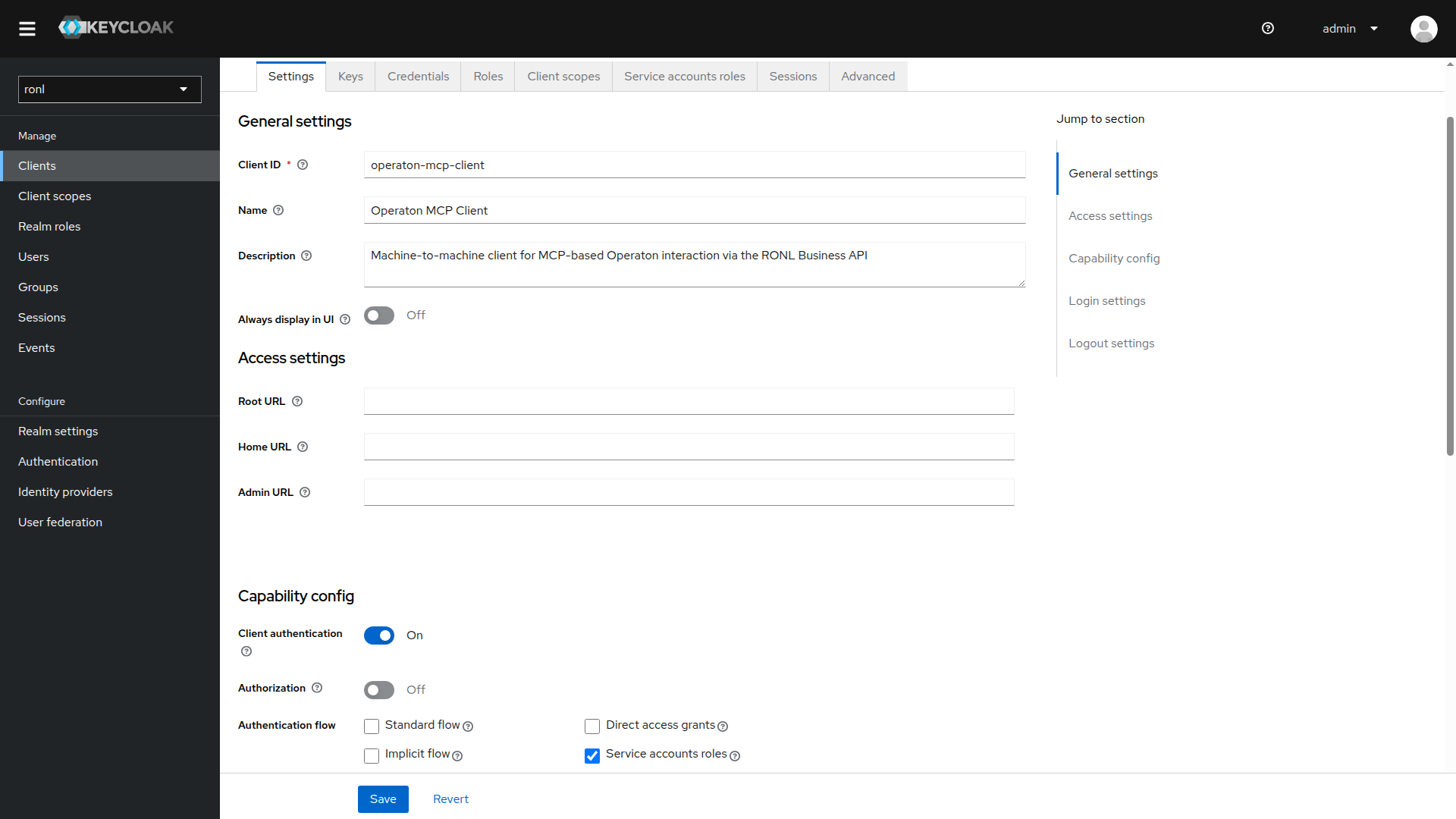
A dedicated Keycloak client operaton-mcp-client is registered in the ronl realm. It uses the Client Credentials grant — no browser redirect or user login is involved. No municipality or organisation_type claims are present in the token by design.
| Setting | Value |
|---|---|
| Client ID | operaton-mcp-client |
| Grant type | client_credentials |
| Token endpoint | https://acc.keycloak.open-regels.nl/realms/ronl/protocol/openid-connect/token |
| Audience | ronl-business-api (set via audience mapper) |
| Municipality claim | absent — M2M client has no tenant scope |
The token endpoint for production will be https://keycloak.open-regels.nl/realms/ronl/protocol/openid-connect/token.
M2M — Operaton
packages/backend/src/routes/m2m.routes.ts registers all endpoints under /v1/m2m. All are protected by jwtMiddleware only — no tenantMiddleware.
Process
| Method | Endpoint | Description |
|---|---|---|
GET |
/v1/m2m/process |
List active process instances across all organisations. Query params forwarded to Operaton. |
POST |
/v1/m2m/process/:key/start |
Start a process instance by definition key |
GET |
/v1/m2m/process/history |
Query process history. Request body forwarded to Operaton. |
GET |
/v1/m2m/process/:id/status |
Get process instance status |
GET |
/v1/m2m/process/:id/variables |
Get current process variables (plain values) |
GET |
/v1/m2m/process/:id/historic-variables |
Get final variable state of a completed instance |
GET |
/v1/m2m/process/:id/decision-document |
Fetch the DocumentTemplate linked via ronl:documentRef. Returns 404 DOCUMENT_NOT_FOUND if no ronl:documentRef is present. |
GET |
/v1/m2m/process/:key/start-form |
Fetch the deployed Camunda Form schema for a process start event. Returns 404 FORM_NOT_FOUND if no form is linked. |
GET |
/v1/m2m/process/:key/variable-hints |
Fetch deduplicated variable names and types from history |
DELETE |
/v1/m2m/process/:id |
Cancel a process instance |
Task
| Method | Endpoint | Description |
|---|---|---|
GET |
/v1/m2m/task |
List all open tasks across all organisations |
GET |
/v1/m2m/task/:id |
Get a single task by ID |
GET |
/v1/m2m/task/:id/variables |
Get all process variables for a task |
GET |
/v1/m2m/task/:id/form-schema |
Fetch the deployed Camunda Form schema for a task. Returns 404 FORM_NOT_FOUND if no form is linked. |
POST |
/v1/m2m/task/:id/claim |
Claim a task. Body: { "userId": "..." } (optional — falls back to token subject) |
POST |
/v1/m2m/task/:id/complete |
Complete a task with submitted variables |
Decision
| Method | Endpoint | Description |
|---|---|---|
POST |
/v1/m2m/decision/:key/evaluate |
Evaluate a DMN decision table by key |
GET |
/v1/m2m/decision/:key |
Fetch decision definition metadata |
POST /v1/m2m/decision/:key/evaluate request body:
Test script
scripts/test-m2m-routes.sh validates all M2M routes against a running instance. It obtains a token via Client Credentials, checks JWT claims, exercises every active operation, and verifies tenant isolation remains intact on the standard caseworker routes.
Prerequisites: curl and jq must be available on $PATH. The operaton-mcp-client Keycloak client must be configured with CAMUNDA_BPM_AUTHORIZATION_ENABLED=false on the target Operaton instance (or equivalent authorization grants in place) — without this, process, history, and deployment endpoints return 404.
Usage:
Overridable environment variables:
| Variable | Default | Description |
|---|---|---|
BASE_URL |
https://acc.api.open-regels.nl |
RONL Business API base URL |
KEYCLOAK_URL |
https://acc.keycloak.open-regels.nl |
Keycloak base URL |
CLIENT_ID |
operaton-mcp-client |
Keycloak client ID |
CLIENT_SECRET |
(required) | Keycloak client secret |
DECISION_KEY |
TreeFellingDecision |
DMN key used for the decision evaluate test |
What it checks:
- Token obtained and JWT claims valid (
azp,aud,municipalityabsent) - All active operations return HTTP 200 (404 accepted for
form-schema,start-form,decision-document— resource may not exist in the deployment) - All disabled operations return
403 OPERATION_NOT_PERMITTED GET /v1/taskwith an M2M token returns403 MISSING_TENANT— confirming tenant-scoped routes remain isolated
Curation gate
The M2M_ALLOWED_OPERATIONS constant at the top of m2m.routes.ts controls which operations are active. Comment out any entry to disable that operation — no other code changes are required:
const M2M_ALLOWED_OPERATIONS = [
  'process.list',
  'process.start',
  // 'process.delete',   // ← uncomment to disable
  'task.list',
  'task.complete',
  // ...
] as const;
A disabled operation returns 403 OPERATION_NOT_PERMITTED.
Dedicated Operaton instance
The M2M routes can be pointed at a separate Operaton instance by setting OPERATON_M2M_BASE_URL. When unset, they share the default instance with all other routes.
| Variable | Required | Description |
|---|---|---|
OPERATON_M2M_BASE_URL |
No | Base URL for the M2M Operaton instance. Falls back to OPERATON_BASE_URL when absent. |
OPERATON_M2M_USERNAME |
No | Basic auth username for the M2M instance |
OPERATON_M2M_PASSWORD |
No | Basic auth password for the M2M instance |
On ACC, the M2M routes are pointed at https://operaton-doc.open-regels.nl/engine-rest.
Audit logging
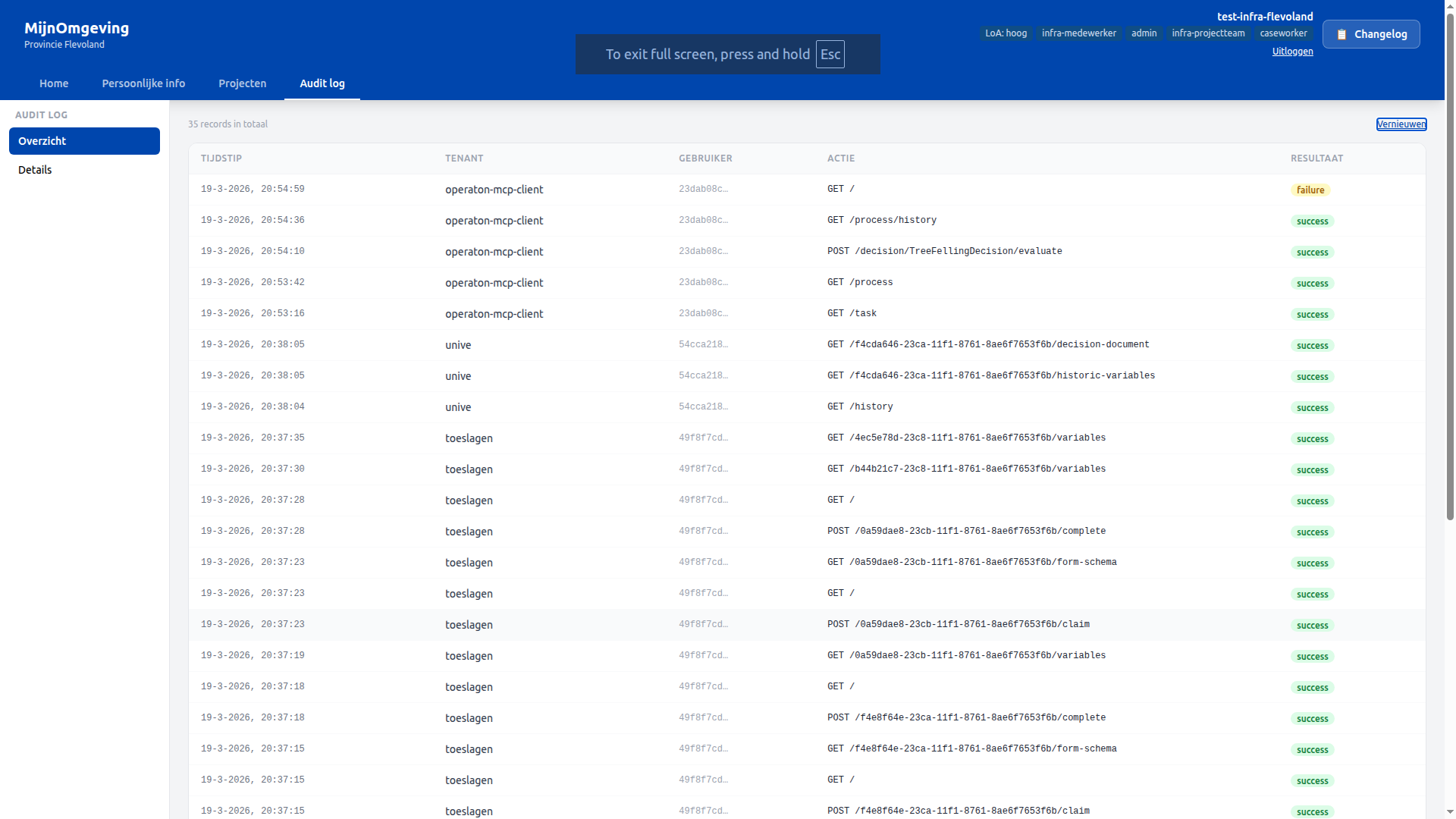
All M2M requests are written to the audit_logs table. Because the operaton-mcp-client token carries no municipality claim, the tenant_id column is populated with the Keycloak azp claim — i.e. operaton-mcp-client — making M2M activity queryable and distinguishable from human caseworker activity.
Testing with curl
1. Obtain a token
TOKEN=$(curl -s -X POST \
  https://acc.keycloak.open-regels.nl/realms/ronl/protocol/openid-connect/token \
  -H "Content-Type: application/x-www-form-urlencoded" \
  -d "grant_type=client_credentials" \
  -d "client_id=operaton-mcp-client" \
  -d "client_secret=<secret-from-keycloak>" \
  | jq -r .access_token)
2. Verify the token claims
Expected: aud contains ronl-business-api, azp is operaton-mcp-client, no municipality claim.
3. List all tasks (unfiltered across all organisations)
4. List all active process instances
5. Evaluate a decision
curl -s -X POST \
  https://acc.api.open-regels.nl/v1/m2m/decision/TreeFellingDecision/evaluate \
  -H "Authorization: Bearer $TOKEN" \
  -H "Content-Type: application/json" \
  -d '{"variables": {"treeDiameter": 45, "protectedArea": false}}' \
  | jq .
6. Get process history (body forwarded to Operaton)
curl -s -X GET \
  https://acc.api.open-regels.nl/v1/m2m/process/history \
  -H "Authorization: Bearer $TOKEN" \
  -H "Content-Type: application/json" \
  -d '{"sorting": [{"sortBy": "startTime", "sortOrder": "desc"}]}' \
  | jq .
7. Confirm tenant-scoped routes are still blocked
Expected: MISSING_TENANT — the token carries no municipality claim so tenantMiddleware rejects it, confirming the original caseworker routes remain fully isolated.